Is Digital Marketing Worth It? Pay, Costs and Real Results
Is digital marketing worth it? Measure returns with trackable calls and bookings, and compare job pay, course costs, and what one month can teach you.

Digital marketing is the work of using online channels such as search, websites, email, social media, and paid ads to attract and keep customers. It can pay off for businesses when accurate listings, useful content, and well-managed campaigns bring measurable calls and bookings, and it can offer career opportunities for people who build practical skills and prove results. Start with low-cost basics, track outcomes, and weigh the time, tools, training, and competition before investing more.
Think about the last time you paid for something meant to bring in customers. Did it earn its keep, or just look good on the wall? Digital marketing raises the same question.
The short answer is yes, it can be worth it, but the real test is simple: does it bring in calls and bookings you can count? That’s true for a shop owner and for someone weighing a career.
Here we cover demand, earnings, costs, risks, and how to get started, with the basics before paid ads.
Demand That Makes Digital Marketing Worth It
Is digital marketing worth it for a business owner? The demand suggests it can be, as long as the effort turns into calls and bookings.
Why demand for digital skills keeps growing
Businesses keep moving online, and nearly every kind of local shop needs help keeping up.
A 2016 marketing trends paper cites the research firm eMarketer, which estimated that digital advertising budgets would surpass spending on TV, print, radio, outdoor, and directories in 2017.
The pandemic sped that up for many owners, and the trend has held.
Start with these basics before you spend a dollar on ads:
- Map listing: keep your hours current on your Google Business Profile, the listing that shows up on Google Maps.
- Reviews: ask happy customers for recent ones.
- Fast site: make sure your website loads quickly on a phone.
Picture a dental office where the front desk hears ‘Are you open Saturday?’ all week. Correct hours on the listing mean fewer of those calls and more time to book patients.
Market size and how fast it’s growing
The numbers back up the trend:
- Industry value: digital advertising revenue hit a record $294.6 billion in 2025, per the Interactive Advertising Bureau (IAB).
- Ad spend growth: EMARKETER projects that worldwide digital ad spending growth will stay in the double digits through 2027.
- Growth rate: that 2025 figure reflects a 13.9% year-over-year increase, despite economic and geopolitical uncertainty.
A bigger market only helps when some of it reaches your phone.
Why the market is getting crowded
Strong demand draws competitors. New entrants and online courses flood the market, making entry-level roles harder to stand out in and putting pressure on salaries.
For you, that’s a mixed signal: more choice when you hire, but harder to tell who really knows the work. Ask for results, not just a certificate.
Jobs, Roles and What You Can Earn
Digital marketing covers several roles, each with its own skills and pay. Here’s what they look like and what you can expect to earn.
Career paths and roles you can pick
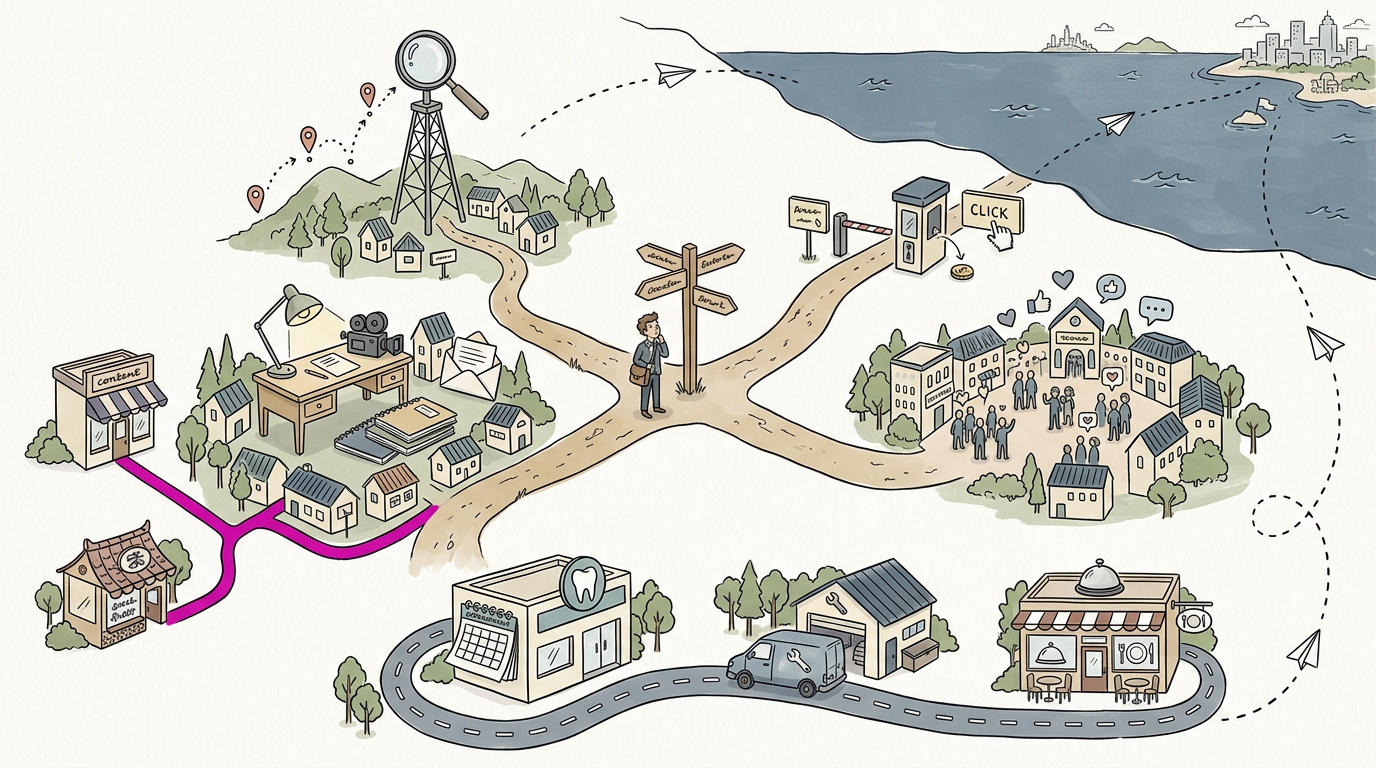
Most roles fall into a few specialties:
- Search engine optimization (SEO): helping search engines find and rank your business online.
- Pay-per-click (PPC): paid ads you pay for only when someone clicks.
- Social media: planning and posting on the platforms your customers already use.
- Content: writing blogs, emails, and videos that answer customer questions.
These skills transfer across industries. Someone who learns how a clinic fills its schedule can apply that thinking to a plumber or a restaurant. You can also build a niche, a focused specialty like local search for service businesses.
Your clients can even be in other cities or countries.
What digital marketing salaries look like
We don’t have verified pay ranges to quote here, so check any figure against current local job postings.
A study on occupation and location specific wages notes that pay in digital-marketing-related roles varies with experience and location, with entry-level and experienced workers earning different amounts.
In plain terms, your first job and your fifth may pay very differently. Since location matters too, compare offers within your own area.
Your earnings also depend on what you can prove. It’s less about your title and more about your results, like ads that bring in booked appointments.
Going freelance or starting your own agency
Freelancing means working for yourself, often on a monthly retainer (a set fee for ongoing work). Building an agency means adding people, so your job shifts toward managing them.
Your own marketing is your best proof, so a clear website and steady reviews show prospects what you can do.
Outsourcing can feel risky, and you might worry a cheaper freelancer will undercut you. Compete on results and clear communication instead. Picture a bakery owner who learns the basics of her own listing, then hires a freelancer for a few months of posts.
Custom-order calls start arriving before the holidays instead of after.
Here’s the trade-off:
- Doing it yourself: full control and lower cash costs, but your own time is the price.
- Hiring an agency: specialist skills and extra capacity, but a bigger bill.
Working remotely with flexible hours
Remote work can happen from anywhere with a laptop and a solid internet connection. Hybrid (part office, part home) mixes the two, though some roles still ask for in-person meetings.
Campaigns don’t always need a nine-to-five, so you can often set your own hours. Flexibility only helps if you set limits, like protected evenings and clear availability for clients.
Marketing also rewards curiosity. You test a headline, see what people click, and try again. It’s less about following a script and more about testing. Keep going.
Can I Learn Digital Marketing in 1 Month?
Yes, you can learn the basics in a month, though you won’t become an expert.
The main channels and tools to learn
Start with these five channels:
- Search engine optimization (SEO): getting found in search.
- Pay-per-click (PPC): ads you pay for only when someone clicks.
- Email: keeping past customers coming back.
- Social media: showing your work where people scroll.
- Content: blog posts that answer questions before people call.
Google Analytics shows where website visitors come from, and Google Ads is where you buy search ads. Social management tools schedule your posts ahead of time. Data analysis ties it together: focus on calls and bookings, not likes.
Test a small ad budget and track every call. Picture a plumber who asks every caller how they found him. Those answers tell him whether to spend more.

Building real experience you can show
Reading gets you started, but doing the work is what sticks. The 70/20/10 rule splits learning roughly into 70% hands-on work, 20% feedback from others, and 10% formal courses.
- Your own blog or website: a place to practice.
- Freelance projects: small paid jobs with real deadlines.
- Internships: supervised experience on a real team.
- Case studies and portfolio: a record of what you did and what changed.
Real-world application ties these together. Consider a salon owner who updates her Google Business Profile, the free listing with her hours, then tracks whether weekend booking calls go up. That’s her first case study.
Meet people and stay current
- Industry events and conferences: face time with people who’ve already tested what works.
- Online communities: forums where you can ask questions and learn from others’ mistakes.
- Following industry leaders: a short list of people who share what’s working.
Stay curious, but stay selective.
Whether Formal Courses Are Worth the Money
Is a formal course or degree worth the cost? It depends on the job you need done and the time you can spare.
What formal courses and degrees offer you
- Structured learning. Lessons follow a set order, so you know what to study next.
- Hands-on projects and placements. Real assignments let you practice before you’re on the clock.
- Portfolio building. Finished projects become examples you can show clients.
- Networking and mentorship. Instructors and classmates can become mentors and contacts.
- Faster than degrees. Shorter programs can get you up to speed sooner than a degree.
- Certifications. A credential you can show when someone asks what you know.
Costs, returns and risks to weigh
- High tuition or course fees. Compare the full amount, not the headline price.
- No guaranteed job. No course can promise work, so your return depends on how you use it.
- Hidden tool costs. Ask whether software and ad accounts cost extra.
- Opportunity cost. The time you give up to study, like evenings with customers.
- Financial aid options. Ask what aid is available before you assume the sticker price.
Judging course quality and what to expect
- Variable course quality. Courses with identical titles can differ widely. Read recent reviews first.
- Too much theory. Favor courses that help you do the work, not just hear about it.
- Unrealistic expectations. A course teaches skills but can’t promise quick results.
- Misleading placement claims. Ask how placement rates are counted and get it in writing.
Consider a plumber’s office manager who spends three weeks on paid-ads theory. A short course on the listing customers see when they search nearby would have gotten her calls sooner.

Cheaper ways to learn without a degree
- Free online resources. Guides and videos cover the basics at no cost.
- Certificates and diplomas. Shorter paid programs give you a credential in less time.
- Short courses and workshops. One evening or weekend can cover the skill you need now.
- Internships and on-the-job training. Working beside someone experienced builds skills you can use right away.
- Self-learning and communities. Online groups let you ask questions and learn from peers.
Think of a bakery owner who spends a few evenings on free tutorials. By month’s end, her business listing shows current hours and photos, so customers know when she’s open.
Start small and aim for progress over perfection.
Hard Parts of Working in Digital Marketing
Digital marketing has real friction, so it helps to know where it bites.
Is AI replacing digital marketing?
Artificial intelligence (AI) is changing the work, not replacing it. It drafts posts and sorts reviews fast, so the doing gets quicker. The deciding still belongs to someone who knows your business.
So is AI replacing marketers? Not entirely. It takes over busywork, and the judgment calls stay with people. Three shifts are worth watching:
- Algorithm updates. Platforms keep changing how they rank content, so last spring’s winning post can quietly fade.
- New tools and AI. Fresh products launch constantly, so pick the ones that fit your work and ignore the rest.
- Continuous learning. Staying current is now part of the job. A short monthly check-in keeps you ahead of the changes.
Steady effort and reliance on paid tools
Results come from steady work, not one big push. A plumber who posts one job photo a week earns more trust than one who posts twelve in an afternoon, then vanishes. Keep showing up.
Much of your visibility lives on platforms you don’t control. If one changes its rules, or a tool you rely on gets pricier, your plan has to bend.
Many tools bill monthly, and the charges add up quietly. Before adding one, ask whether you’ll still open it next month.
New tools take time to learn, and that time comes out of a full day. Block an hour on Friday rather than cramming.
A salon owner paying for three apps who can’t say which one brought in new clients is wasting money. Track calls and bookings for a month, and the tools that earn their keep stand out.
Digital marketing is worth it when it fills your calendar, and it’s worth it as a career when demand, pay, and costs line up with work you’re willing to do. The hard parts are real, so go in with your eyes open.
For a local business, start with the basics before you spend on ads: an accurate profile, a site that works on a phone, and steady reviews. Then count the calls and bookings each month.
Get the basics right, and the calls follow. Count them, and the answer is yours.
References
- Estimating Occupation and Location Specific Wages over the Life Cycle — doi.org (2022)
- The Future of Marketing in 2016: Trends in the New Digital Age — crd-aida.ro (2016)
- Worldwide Digital Ad Spending Growth Will Remain in the Double Digits Through 2027 (billions in digital ad spending worldwide, % change, and % of total media ad spending, 2023-2029) — emarketer.com (2025)
- IAB | Digital Ad Revenue Climbs to Nearly $300B — iab.com (2026)
Questions
What is the 70/20/10 rule in digital marketing?
The 70/20/10 rule describes a learning approach: roughly 70% of learning comes from hands-on work, 20% from feedback and guidance, and 10% from formal courses. In digital marketing, that means practicing on real projects, learning from others, and using courses to build foundational knowledge.
What are 10 careers in marketing?
Ten common marketing careers are SEO specialist, PPC or paid media specialist, social media manager, content marketer, email marketer, digital marketing analyst, marketing strategist, brand manager, market researcher, and marketing manager. Responsibilities and job titles vary by employer and industry.
What are the subjects of digital marketing?
Digital marketing subjects commonly include search engine optimization (SEO), paid advertising or PPC, social media marketing, email marketing, content marketing, analytics, and data analysis. They cover how to reach audiences online and measure outcomes such as calls, bookings, and sales.
What are some popular digital marketing platforms?
Popular digital marketing platforms include Google Search and Google Ads, Google Business Profile, YouTube, Facebook, Instagram, LinkedIn, TikTok, and email services such as Mailchimp. The best choices depend on where a business’s customers spend time and what results it needs to track.
Does digital marketing is a good career?
Yes, digital marketing can be a good career for people who enjoy testing ideas, learning new tools, and using results to improve campaigns. Demand exists across industries, but entry-level competition can be strong, and opportunities depend on your skills, experience, location, and ability to demonstrate results.
Can I learn digital marketing in 1 month?
You can learn the basics of digital marketing in one month, but becoming an expert takes longer. Focus on a few core channels, practice on a website or small project, and get feedback so you can build experience and a portfolio.
Is AI replacing digital marketing?
AI is changing digital marketing rather than replacing it entirely. It can speed up tasks such as drafting posts and sorting reviews, while people remain responsible for strategy, judgment, and understanding a business’s needs.
Is digital marketing well paid?
Digital marketing can be well paid, but earnings vary by role, experience, and location. Compare current local job postings and offers, and remember that demonstrated results can matter as much as a job title.
Sources
- The Future of Marketing in 2016: Trends in the New Digital Age, crd-aida.ro,
- Worldwide Digital Ad Spending Growth Will Remain in the Double Digits Through 2027 (billions in digital ad spending worldwide, % change, and % of total media, emarketer.com,
- IAB | Digital Ad Revenue Climbs to Nearly $300B, iab.com,
- Estimating Occupation and Location Specific Wages over the Life Cycle, doi.org,