Marketing Mix Modeling Explained and How It Works
Marketing mix modeling estimates each channel’s sales impact from past spend and results, then contrasts it with attribution to clarify what reveals.


Marketing mix modeling (MMM) is a statistical method that uses past sales, marketing spend, and other factors to estimate how much each channel contributes to results. It helps teams compare channels, account for delayed effects and diminishing returns, and test budget changes, while attribution tracks individual customer interactions. MMM can guide long-term planning, but it needs clean historical data and expertise, so smaller local businesses may get more value from simpler call-source tracking or promo codes.
Picture this: you run a few ads, post on social media, hand out flyers, and then notice the phone rings more on some weeks than others. Which efforts actually brought those calls in?
That’s the puzzle that marketing mix modeling, or MMM, is built to solve.
In plain terms, marketing mix modeling is a statistical method that looks at your past spending and sales over time to estimate how much each channel contributes to results.
In this post, we’ll explain how it works, how it differs from attribution, and whether it makes sense for a small local business or whether a simpler approach fits better.
Understanding What Marketing Mix Modeling Is
Which of your ads actually brought in calls? Marketing mix modeling (MMM) is one way to find out, and people often confuse it with the 4 Ps, so we’ll sort that out too.
How it measures channel impact on sales
MMM is a statistical technique, an econometric one that applies statistics to business data. It analyzes historical data, meaning your past sales alongside what you spent on each channel.
The result estimates how much each channel contributed, which informs budget decisions. It’s less about whether a channel works and more about how much it adds.
Where marketing mix and media mix overlap
The media mix is the combination of channels you use to reach customers, like radio, print, search, and social. The marketing mix is broader, adding price and promotion along with product and place. The terms often get used interchangeably.
Just remember that media covers where you show up, while marketing covers the whole sale.
Where the 4 Ps idea came from
The 4 Ps (product, price, place, and promotion) are the classic checklist for the marketing mix. A journal article revisiting McCarthy’s framework notes that E. Jerome McCarthy introduced the marketing mix to marketing education in 1960.
The idea took off in the 1980s and 1990s, especially in fast-moving consumer goods (FMCG), meaning everyday products that sell quickly. So the 4 Ps help you think about marketing, while MMM helps you measure it.
What MMM tells you about your spending
MMM is most useful when you’re deciding where the money goes. It can show you:
- Optimal spend per channel: how much each channel should get to earn its keep.
- ROI by channel: return on investment (ROI) for each channel, or how much sales each dollar brings back.
- Sales impact of budget changes: what happens when you move money between channels.
- Advertising vs other factors: how much of your sales come from ads versus things like price changes.
- Time lag of results: how long a campaign takes to show up in sales.
Picture a bakery owner who splits her budget across a flyer run, a radio spot, and social posts. MMM can show which of those lines up with extra orders, so next month’s money moves toward what’s working.
If the radio spot takes a while to pay off, she won’t cut it too soon. Less guessing, more clarity.
How MMM Works Under the Hood
Marketing mix modeling sounds technical, but the core idea is simple: it estimates what each marketing dollar contributed. Here’s how we’ll break it down.
Gathering the data a model needs
The inputs include a dependent variable (usually sales), marketing variables (spend by channel), and control variables like pricing, seasonality, and competitor activity. Since pricing is one of those controls, the definition of price in marketing is a useful place to start.
According to a new research framework for Marketing Mix Modeling, marketing mix models analyze historical sales and marketing spend alongside relevant control variables.
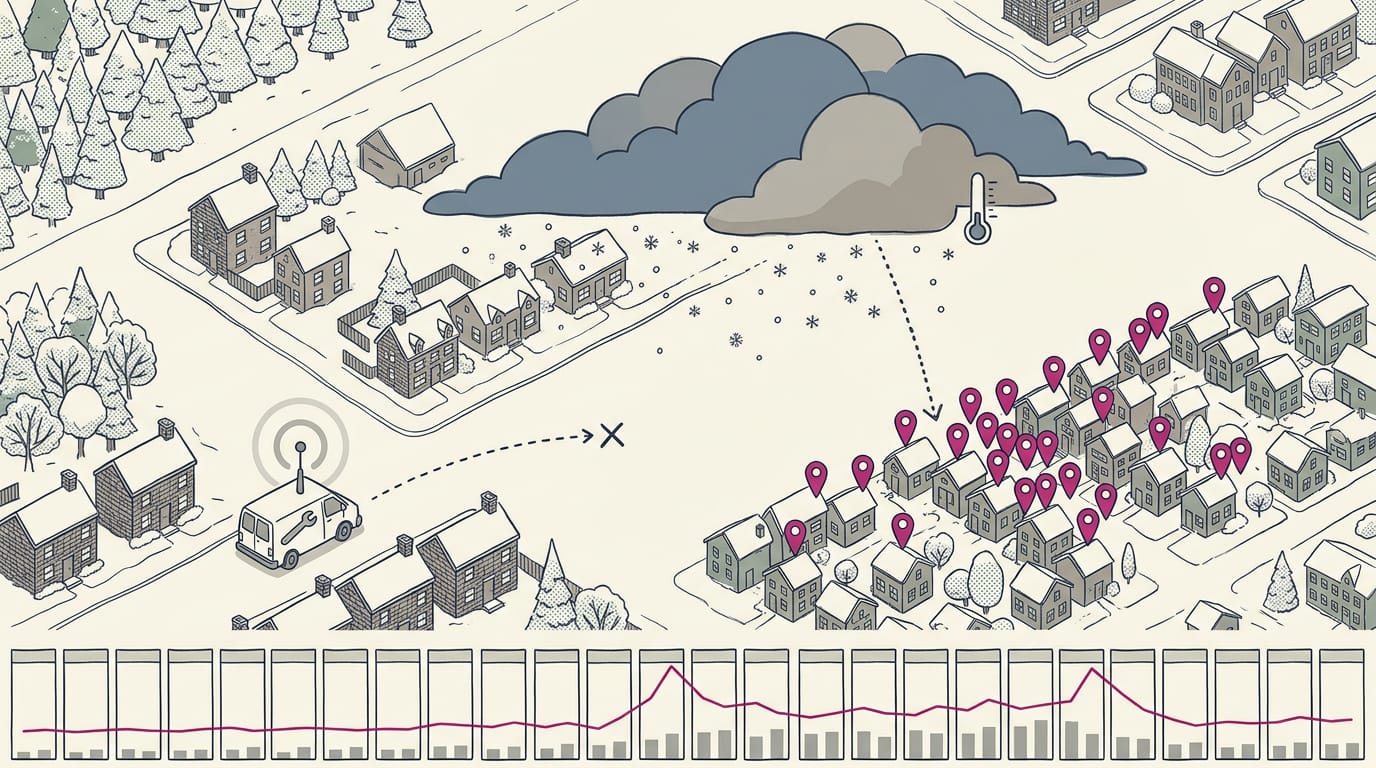
Think of a plumber with search ads, mailers, and a winter radio spot. Without the cold-month pattern, the model might credit that radio spot for a rush the first cold snap caused. Data quality matters more than fancy math.
Plan on two to three years of records, with sales and spend lined up by week or month, and account for local seasonality and weather effects.
The statistical methods behind the models
Multiple linear regression estimates how much each factor moves sales while holding the others steady. Time-series analysis keeps your records in order, so last month can inform this one.
Adstock captures carry-over, since a mailer keeps working for weeks after it lands. Diminishing returns transformations reflect that each extra dollar buys a little less.
Frequentist methods give one best estimate with a range of uncertainty. Bayesian methods start with what you already believe and update it as data arrives. Machine learning can catch complex patterns but usually needs more data and is harder to explain.
The real choice is how you handle uncertainty, not which math is right.
What the results show you
Base sales are what you’d likely sell without a marketing push. Incremental sales are the extra the model credits to your channels.
Return on investment (ROI) shows a channel’s total payoff. Marginal ROAS (return on ad spend for your next dollar) shows whether one more dollar still pays.
Elasticity shows how sales respond to spend changes, and synergy shows when channels work better together. Return curves plot response against spend, so you can see where gains flatten.
Reallocating budget and predicting sales
Budget reallocation means moving dollars from flattened channels to ones with room to grow. Scenario planning lets you test ‘what if’ moves, like swapping radio spend for mailers, before you commit.
A salon owner might see her social ads flatten while direct mail still climbs. She can test that shift on paper first, before moving real money.
Forecasting future sales projects results under a planned budget. Ongoing model refinement means adding new data so estimates stay current.
Following the process from start to finish
- Gather data: pull sales and spend history by week or month.
- Set up the model: pick variables and methods, including adstock and diminishing returns.
- Analyze results: check base versus incremental sales and return curves.
- Adjust and optimize: shift budget toward channels with room to grow.
- Keep testing: rerun the model and compare its forecasts with actual results.
Why Teams Use MMM and Where It Helps
Marketing mix modeling (MMM) earns its keep when marketing runs in too many places for one report to cover.
Seeing online and offline results together
A click report only tracks clicks. MMM asks whether each channel moved results at all.
- Offline channels. Print, radio, and mail can sit in the model beside your digital spend.
- Unclicked channels. A radio spot rarely gets a click but can still drive calls.
- Upper-funnel impact. Early awareness, before anyone’s ready to buy, can still feed later sales.
- Brand impact. MMM can estimate how your overall brand presence moves results over time.
Using data to decide where budget goes
Budget decisions often rest on habit. MMM lets data test your gut feeling before you move money.
MMM shows which channels deserve more money and which deserve less. Picture a plumber whose model shows the print ad adds little. That money can move to the search campaigns bringing in calls.
According to a research paper on the Deep Marketing Mix Model (DMMM), using MMM to guide channel investment and budget allocation can lead to higher incremental return on investment (ROI): the extra return a channel earns beyond what it would have earned anyway.
Cost curves show how results change as spending rises. Early dollars may work harder than later ones. More isn’t always better.
Planning ahead and forecasting performance
- Forecast performance. Estimate what a planned budget might bring before you commit to it.
- Long-term effects. Some marketing pays off slowly, and MMM can account for that.
- Competitive insights. Spotting outside pressure, like a rival’s big promotion, helps you read your results more clearly.
- Strategic planning. Put forecasts, long-term effects, and competitive context together and you’re planning, not guessing.
How MMM Compares to Attribution and Incrementality
People often confuse attribution and incrementality with marketing mix modeling (MMM). Let’s sort out how each one differs.
How MMM differs from multi-touch and last-click
Multi-touch attribution (MTA) follows individual clicks, while MMM works with totals. That makes MMM a big-picture view, not a person-by-person one, and it’s built for the long term, while MTA works in real time.
Last-click gives all the credit to the final touch, so a bakery’s TikTok video that sparks a visit gets ignored if the customer later searches the shop’s name. Platforms also over-report, claiming credit for sales that would have happened anyway.

Pairing MMM with other measurement methods
These methods work best together:
- Hybrid MMM plus MTA. Use MMM for budget planning and MTA for day-to-day tweaks.
- Calibrate attribution with MMM. If MTA credits a channel far more than MMM does, check it before shifting money.
- Validate with geo-lift tests. Boost ads in one area, hold steady in another, and compare. A plumber could see whether calls rise in the boosted town.
- Incrementality testing. It measures the extra sales ads caused, beyond what would have happened anyway.
When last-click and MMM ROAS disagree
A channel can show zero last-click return on ad spend (ROAS) while MMM says it’s pulling its weight. Picture a dental office that cuts its TikTok budget because last-click shows nothing.
Soon after, fewer people search for the practice by name, and the new-patient calendar thins.
That’s the halo effect of prospecting: early reach lifts branded searches, and the search takes the credit. Left alone, that’s misallocated budget: money drifts toward channels that collect credit but don’t create demand.
MMM helps you spot that. Check before you cut.
Why More Marketers Are Turning to MMM
Tracking’s gotten harder, and that’s pushing teams toward marketing mix modeling (MMM).
How privacy rules are limiting tracking
Several shifts make tracking harder:
- Cookie deprecation. Browsers are phasing out third-party cookies, the tracking files that follow visitors.
- Apple’s changes. Its App Tracking Transparency (ATT) and Intelligent Tracking Prevention (ITP) limit tracking.
- Privacy laws. The General Data Protection Regulation (GDPR) and California Consumer Privacy Act (CCPA) restrict data collection.
- Ad blockers. They stop tracking code before it loads.
- No user-level tracking needed. MMM works on totals, not people.
A dental office running search ads and mailers only needs monthly spend per channel and new-patient counts from its booking log to get started.
Tracking customers across messy journeys
Customers rarely follow a straight line. They might see your van, read reviews, click a search ad, then call a week later. Those steps are fragmented touchpoints, small contacts spread across channels.
Platforms credit a sale only within a set lookback window after a click, so late callers don’t count. Each platform may also claim the same booking, creating duplicate platform conversions.
A plumber whose search ad, social post, and yard sign all claim the same Tuesday call is counting one job three times. Platforms count claims. MMM counts calls.
How AI is making models more accurate
Building an MMM once took specialist analysts. Artificial intelligence (AI) changes that: machine learning spots patterns in your data, weighs seasonality and promotions, and sharpens as it learns.
Tools built for specialists now fit small teams, and more factors tend to mean more accurate models.
For example, a salon owner can see whether her spring promotion or social posts drove more bookings, then shift next month’s budget to the winner.
Getting Started and Choosing Tools
Before you commit to a marketing mix modeling (MMM) approach, decide who will do the work. Your options run from building it yourself to paying a vendor to do it for you.
Building in-house or using a platform
Building one in-house with regression, a method that estimates how much each channel moves sales, can require statistical expertise.
The Springer Nature paper Open-Source Media and Marketing Mix Modeling notes that many digital-first advertisers have no experience with these models and often lack the resources to build that expertise internally.
Budget for a statistician, or an analyst who knows the method, whether you hire one or pull someone off other work. Most owners don’t have spare hours.
Automated MMM tools run most of the modeling for you, but you still need someone to check the data going in and read the results coming out.
Open-source tools fall between building from scratch and buying a platform. The code is free, but you still need statistical skills to set it up and trust the output.
A dental office manager juggling scheduling and billing can’t realistically build a model herself. A vendor’s scenario planner could let her test a what-if shift from print to search before she spends a dollar.

Key features of vendor platforms
Vendor platforms bundle the modeling with the tools around it. Look for these features:
- Scenario planner: tests what-if budget changes before you spend.
- AI media planner: uses artificial intelligence (AI) to suggest how to split your budget across channels.
- Multi-level reporting: shows results for the whole business, by channel, and by campaign.
- Data source integration: combines your sales, booking, and ad data automatically, with no spreadsheet uploads.
Focus less on which features sound impressive and more on which ones you’ll use each month.
Real Examples of MMM at Work
Case studies make MMM feel real, but only if you know how to read them. Start with return on investment (ROI), meaning what each dollar brings back.
Sample spend and ROI comparisons
Three comparisons are worth studying:
- TV vs. influencer ROI. Picture a dental office splitting its budget between a local TV spot and a neighborhood influencer. MMM asks which one is filling the schedule, not just getting attention.
- Retail brand channel assessment. A boutique owner can see which channels actually move sales and which ones just come along for the ride.
- Facebook diminishing returns. Picture a bakery that keeps raising its Facebook budget while orders stay flat. Past a certain point, each extra dollar buys less. Sometimes a lot less.
How well-known brands used MMM
Kellogg’s is cited as a brand example in discussions of marketing mix modeling. A research paper on its marketing mix analyzes product, price, place, and promotion, and how far Kellogg’s has globalized or internationalized its approach in each area.
Apple and Starbucks come up in these discussions too, but our sources don’t show how either one used MMM, so we won’t guess.
The next three need the same caution:
- Verizon’s marketing mix. Our sources don’t include the details, so treat any headline as a question, not a result.
- American Express’s shift to MMM. Ask what changed and why before you copy the move.
- The audio channel case. Ask what was measured before you chase it.
Brand stories are interesting, but your own numbers should decide your next move.
Challenges to Expect and Best Practices
Marketing mix modeling (MMM) can be powerful, but it asks a lot before it pays off. Here’s what usually gets in the way.
What makes MMM hard to get right
- Heavy data requirements. It needs a long run of clean sales and ad spend records. Picture a plumber who switched booking software mid-year. Half their sales history now sits in the old system, so the model has little to learn from.
- Resource intensive. Building and running it takes real time or a paid analyst.
- Complexity and trust issues. The math is hard to follow, which makes results easy to accept without checking.
- Slow to adapt. Results reflect past patterns, so new channels take a while to show.
- Historical data limits prediction. What worked last year may not hold after a price change.
- Hard to set up. Organizing the inputs is often the hardest step.
So is it worth it locally? For a single shop on a modest budget, the effort tends to outweigh the payoff. Not yet. Start with the simpler methods below.
Habits that make MMM work well
- Define clear objectives. Pick one question, such as which channel brings in bookings, before you touch any data.
- Collect high-quality data. Name campaigns consistently and log every booking against its spend.
- Choose suitable technique. For small budgets, simpler tools often tell you enough: tracking calls by source, or giving each channel its own promo code.
- Update models regularly. Validate each result by checking it against what you see at the counter, and prefer one you can explain over one that just looks impressive.
For most local businesses, the takeaway is simple: know which efforts bring people through the door, then put your time and money behind them. Once you know which efforts bring people through the door, the next step is a marketing strategy for small business.
MMM is powerful for large teams with plenty of historical data, but it’s rarely the first tool a shop or clinic needs.
Start small this week: ask every new caller how they found you and write it down. Those simple habits build a clear picture over time. The best marketing mix is the one you can actually see working.
References
- Adapting Mccarthy’s Four P’s for the Twenty-First Century — journals.sagepub.com
- DMMM: Deep Marketing Mix Model for Optimal Budget Allocation — aisel.aisnet.org (2025)
- Open-Source Media and Marketing Mix Modeling: Practice-Oriented Overview, Challenges, Opportunities | Customer Needs and Solutions — link.springer.com (2026)
- A new framework for Marketing Mix Modeling: Addressing Channel Influence Bias and Cross-Channel Effects — doi.org (2023)
- Kellogg’s – internationalisation versus globalisation of the marketing mix — doi.org (2001)
- 12 Marketing Strategy Case Studies from Leading Brands — vivaldigroup.com (2026)
Questions
What is the 3-3-3 rule for marketing?
The 3-3-3 rule for marketing is a time-management framework: spend three hours on strategy, three hours creating or distributing marketing, and three hours reviewing results. The exact interpretation can vary, so it is best treated as a simple planning guideline rather than a formal marketing standard.
What is MMM media mix modeling?
Marketing mix modeling (MMM) is a statistical method that analyzes historical sales, marketing spending, and other factors to estimate how much each channel contributed to results. Businesses use those estimates to compare channel performance and make budget decisions.
What are the seven steps of the marketing process?
A common seven-step marketing process is: analyze the market, research customers, set objectives, choose a target market, develop a marketing strategy, implement the marketing plan, and measure and adjust results. The exact steps and labels can vary between marketing frameworks.
What are the 4Ps of the marketing mix?
The 4Ps are product, price, place, and promotion. They are a classic framework for planning the marketing mix: what is offered, how it is priced, where it is sold, and how customers learn about it.
What does "marketing mix" mean?
A marketing mix is the set of choices a business makes to market and sell a product or service. It traditionally includes product, price, place, and promotion; it is broader than a media mix, which refers to the channels used to reach customers.
What's MMM in marketing?
MMM in marketing usually means marketing mix modeling, a statistical approach for estimating how different marketing channels and other factors affect sales over time. It uses historical data to inform decisions such as how to allocate or shift a budget.
Sources
- Adapting Mccarthy’s Four P’s for the Twenty-First Century, journals.sagepub.com
- A new framework for Marketing Mix Modeling: Addressing Channel Influence Bias and Cross-Channel Effects, doi.org,
- DMMM: Deep Marketing Mix Model for Optimal Budget Allocation, aisel.aisnet.org,
- 12 Marketing Strategy Case Studies from Leading Brands - Vivaldi Group, vivaldigroup.com,
- Kellogg’s – internationalisation versus globalisation of the marketing mix, doi.org,
- Open-Source Media and Marketing Mix Modeling: Practice-Oriented Overview, Challenges, Opportunities | Customer Needs and Solutions | Springer Nature Link, link.springer.com,