What Is Retail Pricing and How Do You Set Shelf Prices?
Retail pricing shows how to turn your costs and markup into a shelf price. Check whether it covers your expenses and leaves money to keep.

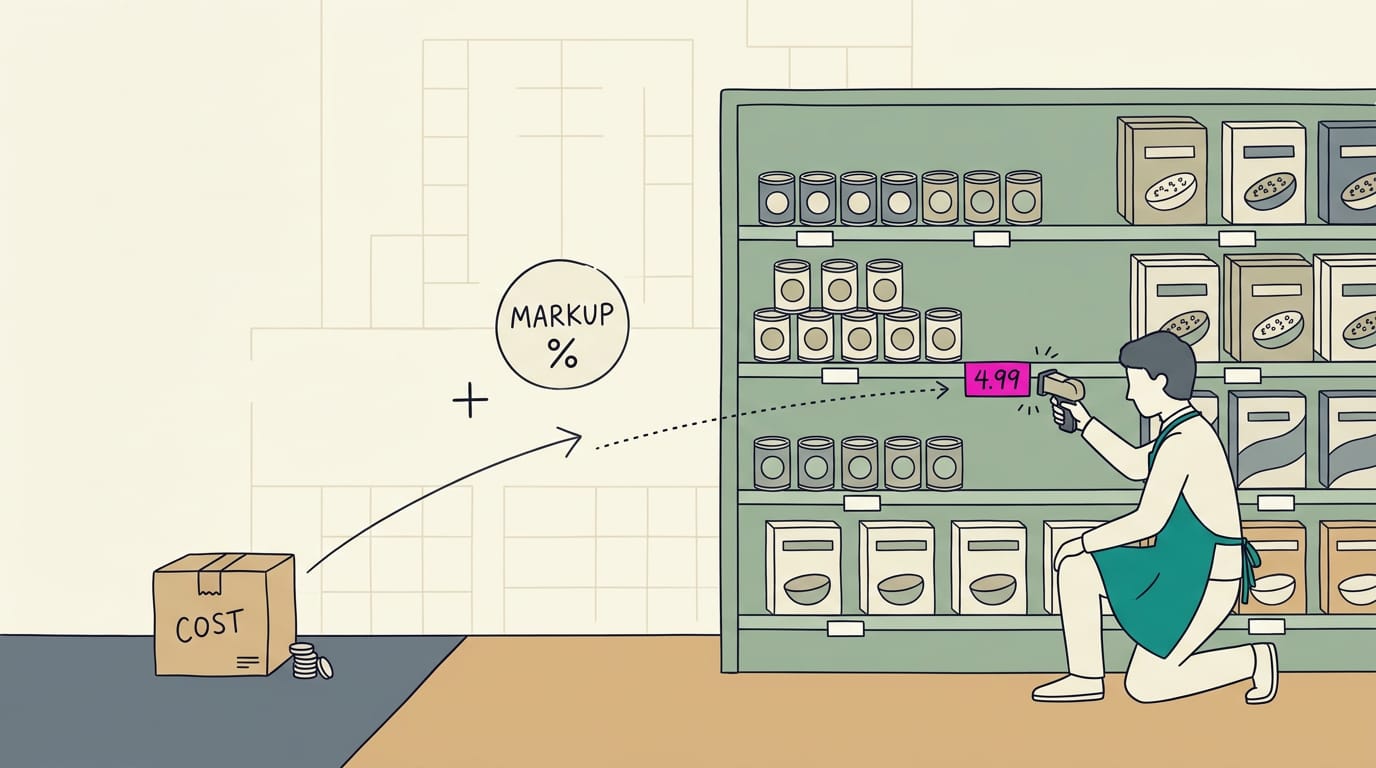
Retail pricing is the process of setting the amount customers pay for goods they buy for their own use, based on what each item costs the retailer and the value customers expect. A practical pricing plan starts with product and handling costs, adds a clear markup, then checks demand, customer expectations, and competing prices. The right price covers costs, supports profit, and gives shoppers a fair reason to choose the store and return.
Picture a customer in your aisle, holding a candle and turning it over to find the price tag. That small moment shapes whether they buy.
Retail pricing is the process of setting the price you charge for each item you sell, so it covers your costs and still leaves you something to keep.
In this post, we’ll cover what retail pricing is, how to work out a shelf price from your costs and a markup (the amount you add on top of what you paid), what shapes those numbers, and how pricing strategy fits in.
You’ll finish with a way to set and check real prices without guesswork.
Understanding What Retail Pricing Is
Before you change a single price tag, get clear on what the terms mean. Several of them get used loosely, so let’s pin them down.
What’s the difference between selling price and retail price?
The selling price is the final amount the customer pays. Retail price means a sale to someone buying for their own use, not for resale, so retail describes the buyer. Shoppers judge that number against what the item seems worth, the perceived value link.
You set the selling price yourself, starting with your cost. Think of a candle shop owner pricing a new scent: she starts with the cost of the jar and wax, then checks that the number still feels fair to the shopper holding it.
How retail and wholesale prices differ
Wholesale prices are what resellers pay, the businesses that buy goods to sell again. Retailers buy in bulk, which brings the per-item cost down, so wholesale sits below retail.
The reseller then adds its own markup, the amount tacked on above its cost. The opposite of retail price is wholesale price, and the product can be identical. What changes is who is buying and why. Same product. Different buyer.
Other price terms worth knowing
Here are the terms you’ll see most:
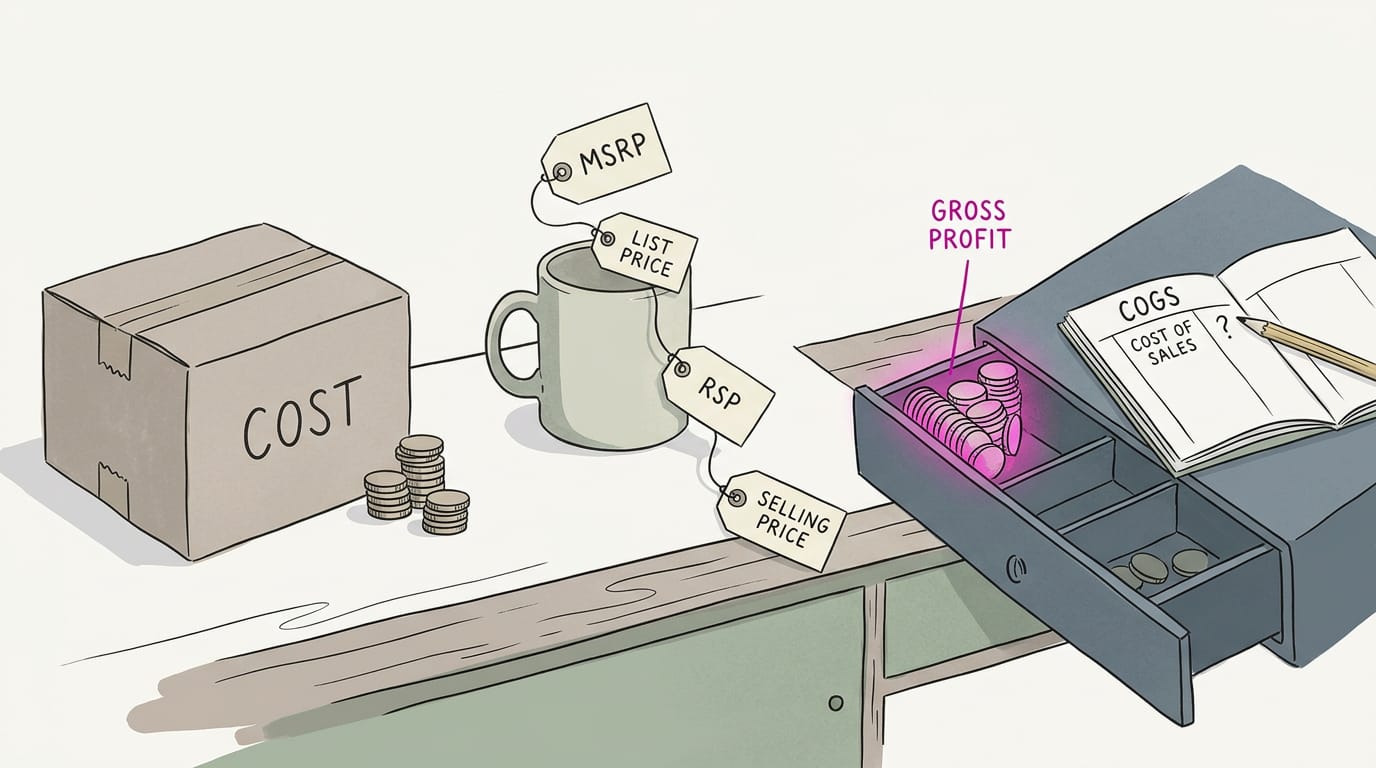
- MSRP (manufacturer’s suggested retail price): the price the maker recommends.
- List price: the posted price before any discounts.
- RSP (recommended selling price): a suggested price you can accept or change.
Your cost for the goods you sold is counted as COGS (cost of goods sold). Retail price minus cost equals gross profit, the money left before rent and bills.
Cost of sales is close to COGS, so check with your bookkeeper which label your reports use.
Working Out Prices from Costs and Markup
Before you set a shelf price, know what each item costs and what you’ll add on top.
What is a retail price in math?
A retail price is your unit cost plus your markup, the amount you add to cover overhead and profit. A hardware store buys drill bits for $20 and adds a 50% markup: $20 × 0.50 = $10, so the shelf price is $30.
That 50% markup means your profit is half your cost: $10 on every box.
Markup is a percentage of cost, while margin is a percentage of price. That same $30 sale is a 33% margin ($10 ÷ $30), not a 50% markup. Same $10, different percentage.
A profit margin calculator does this math for you. In a spreadsheet, type =B2*(1+C2) with cost in B2 and markup in C2. Point-of-sale (POS) systems may also apply markups automatically.
What makes up your total cost
Your cost of goods sold (COGS) includes: - Product: what you pay the supplier - Logistics: freight and receiving - Storage: space to keep the stock - Labor: staff time to unload and shelve
Rent and advertising aren’t COGS. They’re operating expenses, so keep them separate. Ask your accountant where freight and labor belong.
Gross profit is the selling price minus COGS per unit: a $30 item with $22 of COGS leaves $8.
Valuing stock at cost versus retail
Stock has cost value (what you paid) and retail value (what it sells for). At a 50% markup on cost, $1,000 of stock is worth $1,500 at retail.
Many retailers measure markup against retail price, so check which convention your supplier uses.
Shrinkage cost is the value of stock lost to theft, damage, or miscounts. The retail method uses a cost-to-retail ratio to estimate stock value, which helps you track shrinkage.
Why Pricing Matters and What Shapes It
Your price does more than cover costs. It shapes profit, how customers see you, and whether they return.
How right pricing helps your business
Right pricing helps in several ways:
- Maximizing profits. Charge enough that your busy weeks actually pay.
- Avoiding selling at a loss. Every sale should cover its own costs.
- Competitive advantage. A defensible price wins on value, not just the lowest tag.
- Customer loyalty and return visits. A fair-feeling price keeps regulars coming back.
- Balance between too low and too high. Too low costs profit and looks cheap. Too high sends people elsewhere.
How price shapes what customers think
Customers read your price as a message. That message is your brand and your value proposition, the reason someone picks you. It’s less about what you charge and more about what they think it means.
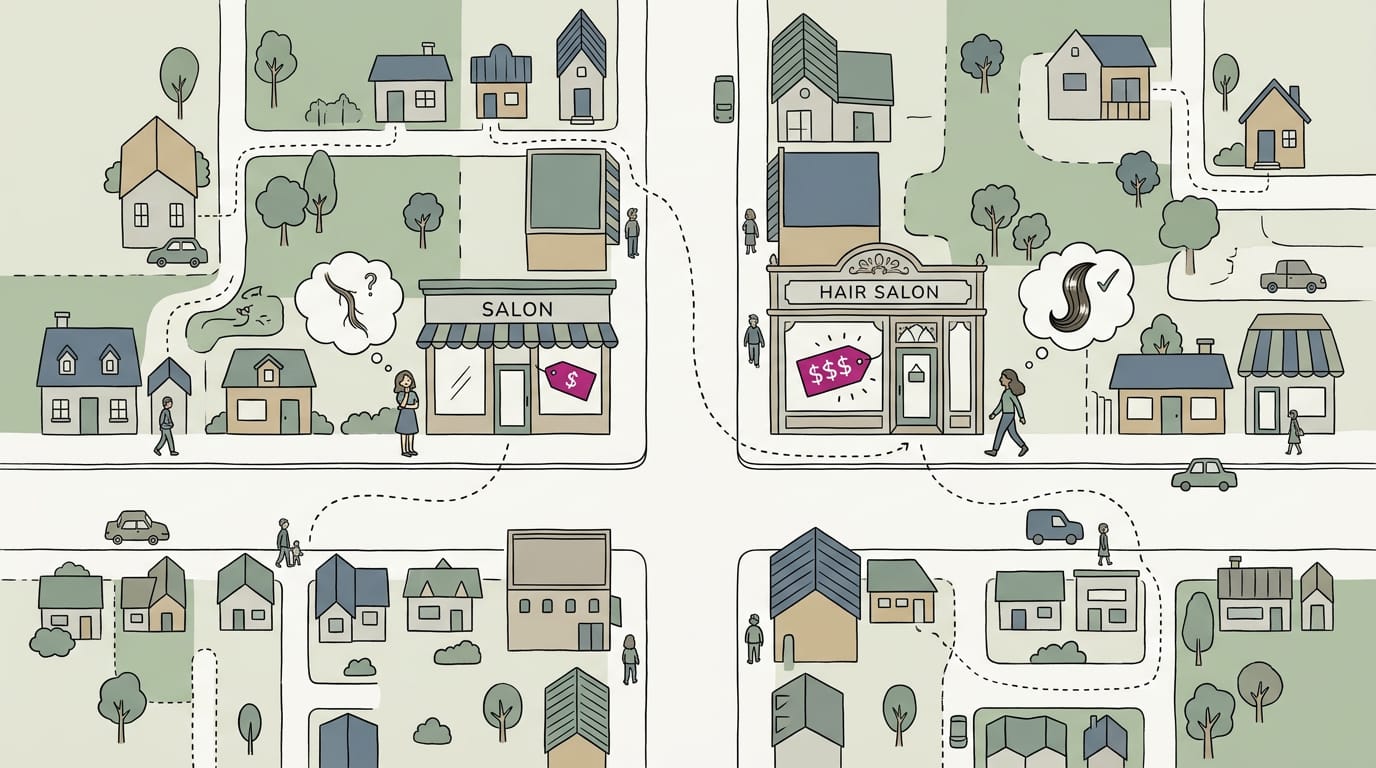
Consider a salon owner who prices her color services at the bottom of the local range. Bookings may rise, but some clients doubt the color will last.
That’s price-value perception: customers weigh what they pay against what they expect back. Price also signals quality.
For consumer products, an integrative review of buyers’ perceptions of product quality suggests price and perceived quality are positively and significantly related.
What inside and outside forces set prices
The 5 P’s of retail are:
- product
- price
- place
- promotion
- people
Some forces sit inside your walls, like labor, marketing, and logistics (getting stock to your shelves). Others sit outside:
- Supplier or manufacturer influence. Their costs set your floor.
- Market competition. Nearby prices set the range shoppers compare.
- Regulations and trends. Rules and shifting tastes limit what you can charge.
- Consumer behavior. Your customers’ budgets decide where your price feels right.
What Is Pricing Strategy in Retail Management?
Pricing strategy is the plan behind every shelf price: how you decide what to charge and why. It’s less about one lucky number and more about a repeatable method you can defend.
Start with costs when setting prices
Your costs set the floor under every price. Three common methods build on them:
- Cost-plus or markup pricing. You add a set percentage to what an item costs you.
- Keystone double-cost pricing. A traditional shortcut that prices an item at twice what you paid.
- Break-even pricing. You find the price where sales just cover your costs, so you know the lowest price that avoids a loss.
The catch is that cost-based pricing covers costs but ignores demand. Think of a candle shop that marks up every item the same way without checking nearby prices. The margin looks great on paper, but if customers balk, the candles stay on the shelf.
When the manufacturer sets your price
The manufacturer’s suggested retail price (MSRP) is what a brand recommends you charge. When that price is uniform, every shop charges the same, so there’s no price differentiation to lean on. You compete on service rather than price.
Discounting below it can strain your relationship with the brand, so check its policy first.
Pricing that plays on buyer psychology
- Value-based pricing. You price by what buyers believe an item is worth, which is common for luxury brands.
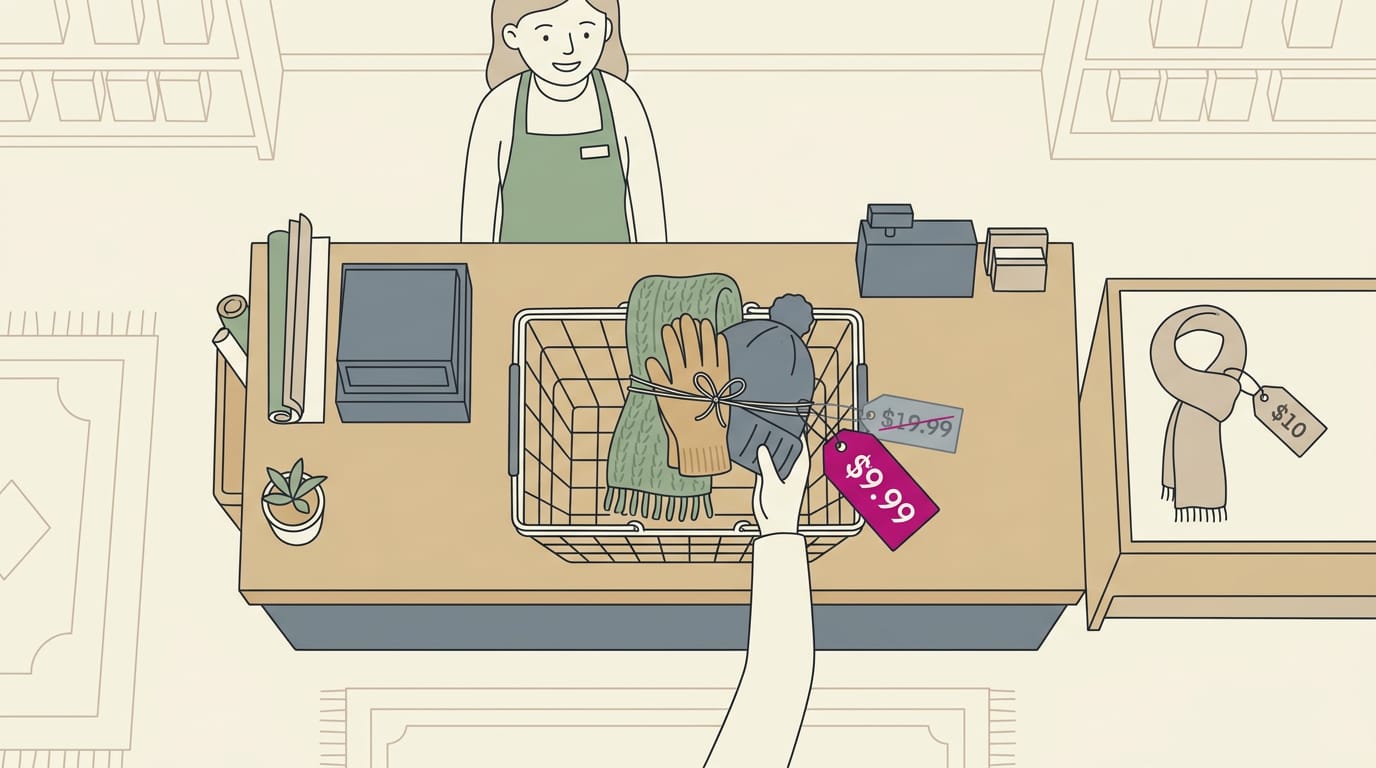
- Psychological $9.99 pricing. A price like $9.99 can feel noticeably cheaper than $10.
- Price anchoring with sale prices. Research on the anchoring effects of advertised reference and sale prices suggests retailers can use sale prices as anchors to make regular prices seem more attractive.
- Bundle pricing. You group related items for one price so customers buy more per visit.
Consider a gift shop that puts a scarf, gloves, and a hat on one tag, so a customer grabs three items instead of one.
How to price against nearby competitors
Competitive pricing means setting your prices with similar shops nearby in mind. It works best alongside your costs, not instead of them.
- Price matching policies. You promise to match a lower price from a competitor, which builds trust but can cut into your margin.
- Monitoring competitor prices. Check nearby competitors’ shelf prices on the items customers ask about most.
- Risk of low-quality perception. Prices far below the market can make customers assume the product is inferior. Be the value choice, not the cheapest one.
A hardware owner who checks drills and paint across the street once a month matches only the few items where it counts.
Pricing new launches and shifting demand
Your prices should move with demand, and when you change a price matters as much as what it is.
- Penetration pricing for launches. You start low to win early sales, then adjust once the item has a following.
- Price skimming. You start high for eager buyers, then lower the price over time.
- Dynamic real-time pricing. You adjust prices as demand shifts, often with pricing software.
- Discount pricing for overstock. You mark down slow stock to clear shelf space.
Choosing and mixing the right strategies
No single method wins every time, so aim for the right mix.
- Match strategy to business. Fit your approach to your costs, customers, and local competition.
- Combine multiple strategies. Pair a cost-based floor with a competitive check rather than relying on one.
- Consult retail experts. A retail consultant or trusted accountant can help you test confusing numbers.
- Large vs small retailer use. Large chains can adjust prices constantly with software. A local shop usually does better with a simpler mix it can review by hand.
Simple and consistent beats clever and forgotten.
Pricing doesn’t have to be guesswork. Start with what each item really costs you, add a markup you can explain, and check that number against what your customers will pay. Keep it simple and steady.
A clear price tells customers what to expect from you, which builds the kind of trust that brings them back. Price with a plan, and every tag on your shelf starts working for you.
References
Questions
What is pricing strategy in retail management?
Pricing strategy in retail management is the repeatable plan a retailer uses to decide what to charge and why. It considers costs, customer demand, perceived value, and competitors so prices cover costs and support the business’s goals.
What is the opposite of retail price?
The opposite of a retail price is generally a wholesale price. Retail prices apply to sales to customers buying for their own use, while wholesale prices are paid by businesses buying goods to resell.
What is a retail price in math?
In math, retail price is the unit cost plus a markup. For example, if an item costs $20 and the markup is 50% of cost, the markup is $10 and the retail price is $30.
What's the difference between selling price and retail price?
Selling price is the final amount a customer pays, while retail price describes a sale to someone buying for their own use rather than for resale. In everyday retail, the terms may refer to the same amount when a customer buys an item at its listed price.