How to Start Digital Marketing for a Career or Business
How to start digital marketing: compare five career paths, learn the core skills, and build a portfolio that helps you land your first role.
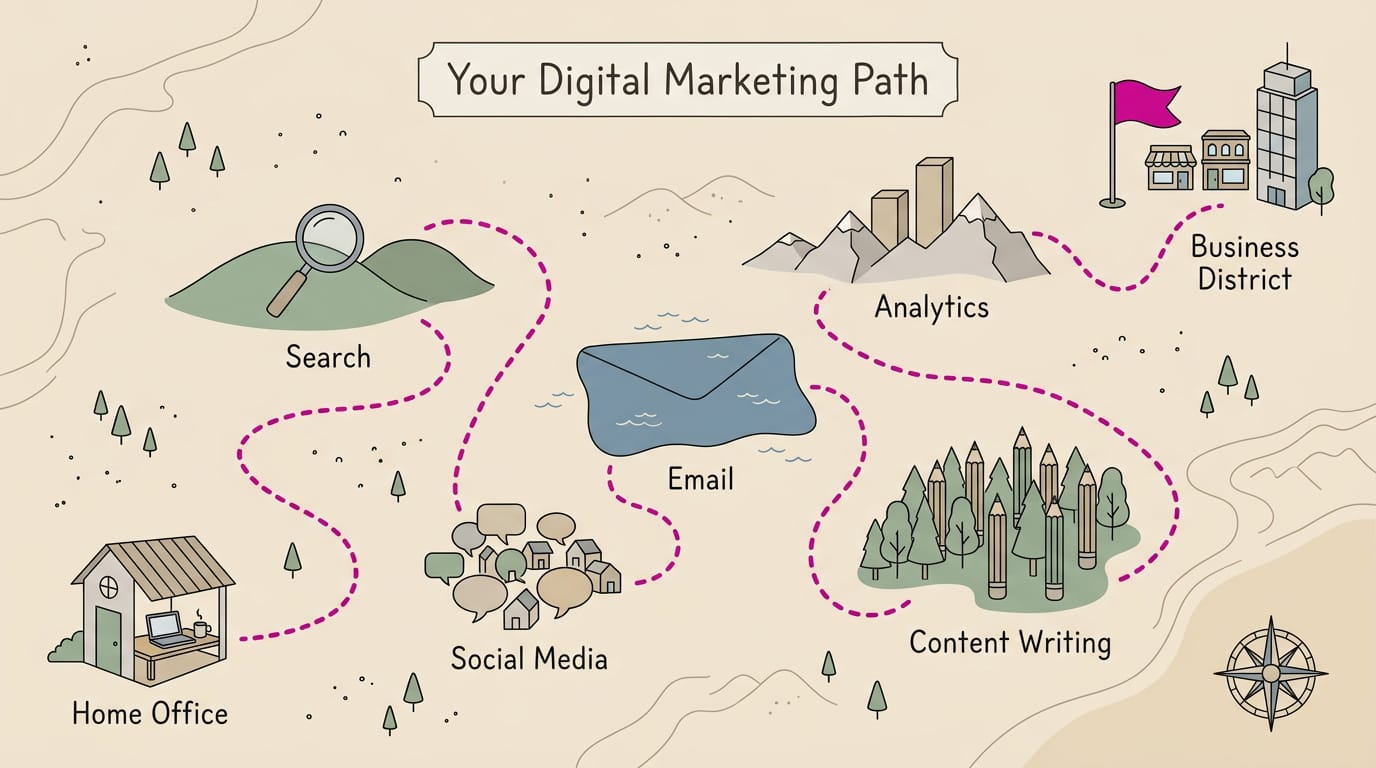
Digital marketing is promoting a business, product, or service online so people can find it, trust it, and take action. Start by learning customer needs, choosing one channel to focus on, and building practical skills through courses, sample projects, or volunteer work; track calls, bookings, and sales rather than clicks alone. For a local business, improve its map listing, reviews, and mobile-friendly website before paying for ads, and use measurable work to build a portfolio or grow results.
Picture a plumber with a leak in the kitchen, searching for help on a phone at 9pm. Digital marketing is how that plumber gets found, trusted, and called. It’s a skill you can learn, whether you want to build a career in it or grow your own business.
In this guide, we’ll cover how to start, from careers and skills to building a portfolio.
If you run a local business, we’ll show you where to begin: your map listing, your reviews, and a fast, plain website, before you spend a dollar on paid ads or social media.
How to Start Digital Marketing
Digital marketing sounds bigger than it is.
What digital marketing actually means
Digital marketing is any online promotion. Traditional marketing leaves you guessing. Digital marketing shows you who clicked, called, or booked.
Most efforts aim for awareness (people know you exist) or sales (they call or book). The internet and social media don’t stop at your front door.
The key ideas and numbers to track
Market research means learning what customers search for and how they behave.
The marketing funnel is the path from stranger to customer.
Click-through rate (CTR) is the share who click your ad. Conversion rate is the share who call, book, or buy. Bounce rate is the share who leave right away.
Data guides decisions: if phone visitors keep bouncing, fix that page first.
Track calls and bookings, not clicks. A click that never calls is just noise.
The main channels to market through
- SEO (search engine optimization) helps search engines match your site and listing to nearby searches.
- Content marketing means useful pages or posts that answer common questions.
- Email marketing collects addresses from people who opt in, then sends short messages like appointment reminders.
- PPC (pay-per-click) advertising means you pay for each click. Start with a small, fixed budget.
- Social media marketing means steady posts where customers already are.
- Affiliate, influencer, video, and mobile marketing pay partners for sales, use creators, and reach people on video or phones.
Local owners should put the map listing first, the profile on Google Maps. Picture a bakery owner asked about custom orders. Answering that on her listing turns more calls into orders.
Reviews and a plain, fast website come next, before paid ads or social.
The 3-3-3 rule is a simple shortcut for staying focused.
What Are 5 Careers in Marketing?
Thinking about marketing as a career? Here’s what to expect on demand, pay, and time to start.
Demand for marketers and job growth
Demand is strong. A study in the Athens Journal of Business & Economics notes that digital marketing skills are in high demand, so the skills you build now have a real market.
Jobs are growing too. According to the U.S. Bureau of Labor Statistics, as cited in a Medill marketing outlook post, advertising, promotions and marketing manager roles are projected to grow 8% through 2033, faster than average for all occupations.
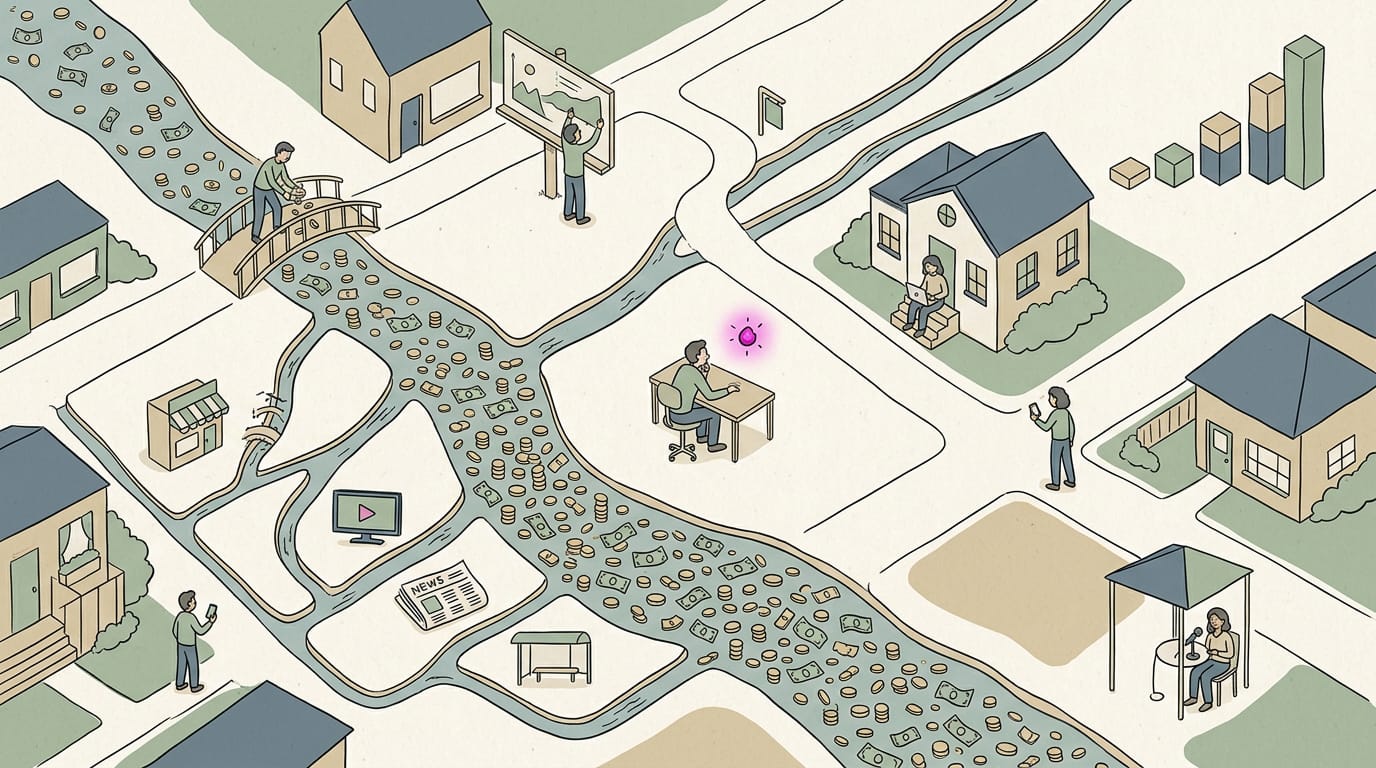
Ad spend, the money businesses put into advertising, is rising. According to the Advertising Association and WARC Expenditure Report, UK advertising investment rose 11.0% year on year in the second quarter of 2026 to £12.3 billion.
That’s money that needs people to spend it well.
Digital channels keep multiplying, and artificial intelligence (AI) tools are joining the toolkit. Our sources don’t say how AI will reshape these jobs, so treat new tools as something to learn, not something to fear.
What marketers earn in the UK
According to Prospects.ac.uk, the average UK marketing salary ranges from £37,500 to £41,000. Treat that as a benchmark, not a promise, since your offer depends on the role and the employer.
How long it takes and how hard
Starting a digital marketing career can take anywhere from a few months to a couple of years. If you want the formal route, edX reports that a bachelor’s degree in digital marketing takes 4 to 6 years, while a master’s program takes 12 to 36 months.
It isn’t overly difficult to start, though. Think of a dental office receptionist who keeps the practice’s online listing accurate and posts a few updates. After a few months, she has real work to talk about in an interview.
The work needs both creativity, to make people stop scrolling, and analytics, which means reading the numbers to see what brought in calls. Good marketers spend less time guessing and more time checking.
Mistakes beginners tend to make
Watch out for these three common missteps:
- Neglecting continuous learning. Tools keep changing, so make learning a habit, not a one-time course.
- Mastering everything at once. Learning every channel in one month leaves you thin in all of them. Pick one, get good, then add another.
- Ignoring soft skills. Clear writing and listening to customers matter as much as the technical work.
Start narrow. Stay curious.
Routes in and Qualifications You Need
Several doors lead into digital marketing, and most don’t require a special credential. Here’s what each route asks of you.
Whether you need a degree
A degree isn’t required. A business or communications background helps because it teaches you how customers think and how to write clearly, but it’s a plus, not a must.
Self-learning and certifications can fill the gap, and an internship adds supervised experience and a reference. What you can show matters more than where you studied. Proof beats paper.
Starting with no experience or budget
You don’t need a budget, only time and a plan:
- Free courses and tools. Free courses teach the basics, and free tools help you schedule posts and track results.
- Volunteer and sample projects. Consider a bakery owner who lets you rewrite her menu descriptions and post weekly specials. She gets fresh content, and you get a before-and-after to show your next client.
- Build online presence. A simple page showing your samples lets anyone who searches your name find proof, not just a claim.
Finding remote and freelance work
Remote and freelance work can be a practical first paid step, since many clients care more about results than location. Look for remote-friendly roles, which you can do from anywhere.
Practice shared documents, video calls, and project boards, since clients expect fluency with them. Filter job boards for remote work and set alerts so new postings reach you first.
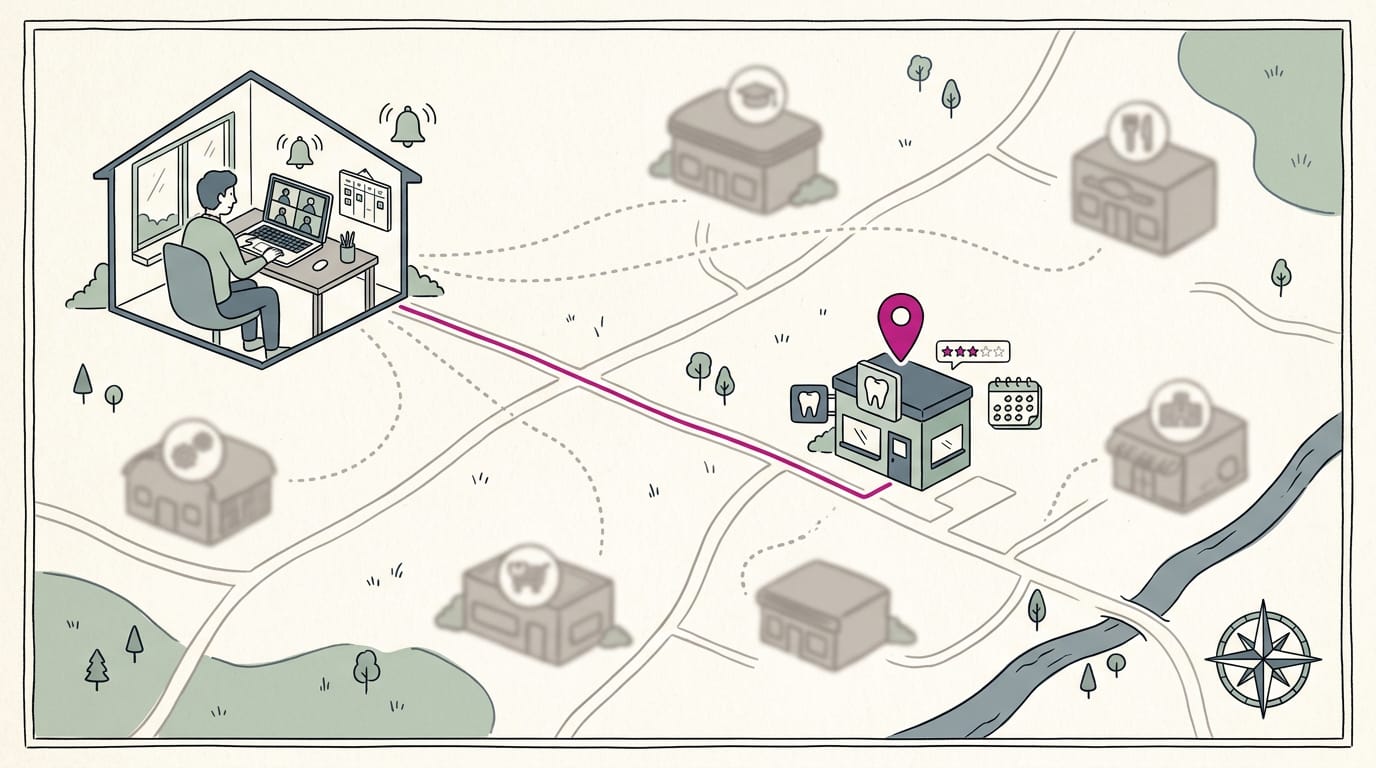
Next, decide on your service offerings. Be specific rather than general. Marketing help is hard to hire, but monthly review requests for local dentists gives a dentist an easy yes.
Growing into a manager role
Managers have worked across several channels, the places marketing shows up, like search, email, social media, and your website, so they see how the pieces connect.
They also oversee campaigns, deciding where the budget goes and checking what’s paying off. A restaurant manager who sees reservation requests jump after one kind of post can shift money toward it and win more bookings.
Managers guide people, too. Coaching the front desk to ask happy customers for reviews, or mentoring a newer teammate, shows you can lead as well as execute. Leadership is practiced, not promised.
Learning the Skills You Need
You don’t need a marketing degree to learn digital marketing. Here’s where to start, which credentials help, and which tools and habits to build first.
Free and structured courses to try
Start with courses that cost nothing and give you a clear path:
- Google Digital Garage: free lessons from Google covering the basics.
- HubSpot Academy: free, self-paced courses for beginners.
- Coursera programs: longer, structured sequences with a set order.
- YouTube free courses: full lessons from working marketers, watched step by step.
- Beginner-friendly online learning: courses labeled for beginners, so you don’t start mid-topic.
Finish one course before starting another. You’ll learn more from finishing one than from sampling five.
Certificates that strengthen your resume
Certificates show employers you’ve finished structured training:
- Google Digital Marketing certificate: a broad credential covering the core of online marketing.
- Meta Blueprint: Meta’s own training for its advertising tools.
- Google Ads certification: proof you understand how Google’s ads work.
They strengthen your resume and your confidence, since you can explain the work without guessing. Certificates open the door, but experience keeps you in the room.
Pick a specialty and go deep
Broad knowledge shows how the pieces fit. Depth is what gets you hired. Pick one or two channels, such as search or email, and learn them well.
Consider a bakery owner who learns search engine optimization (SEO), the work of getting pages to show up in search results. She studies the phrases customers type, like “birthday cakes near me,” then rewrites her site to match.
Her pages start matching what nearby customers search for, so more of those searches turn into orders. That kind of proof helps you stand out to employers.
The tools you will use most
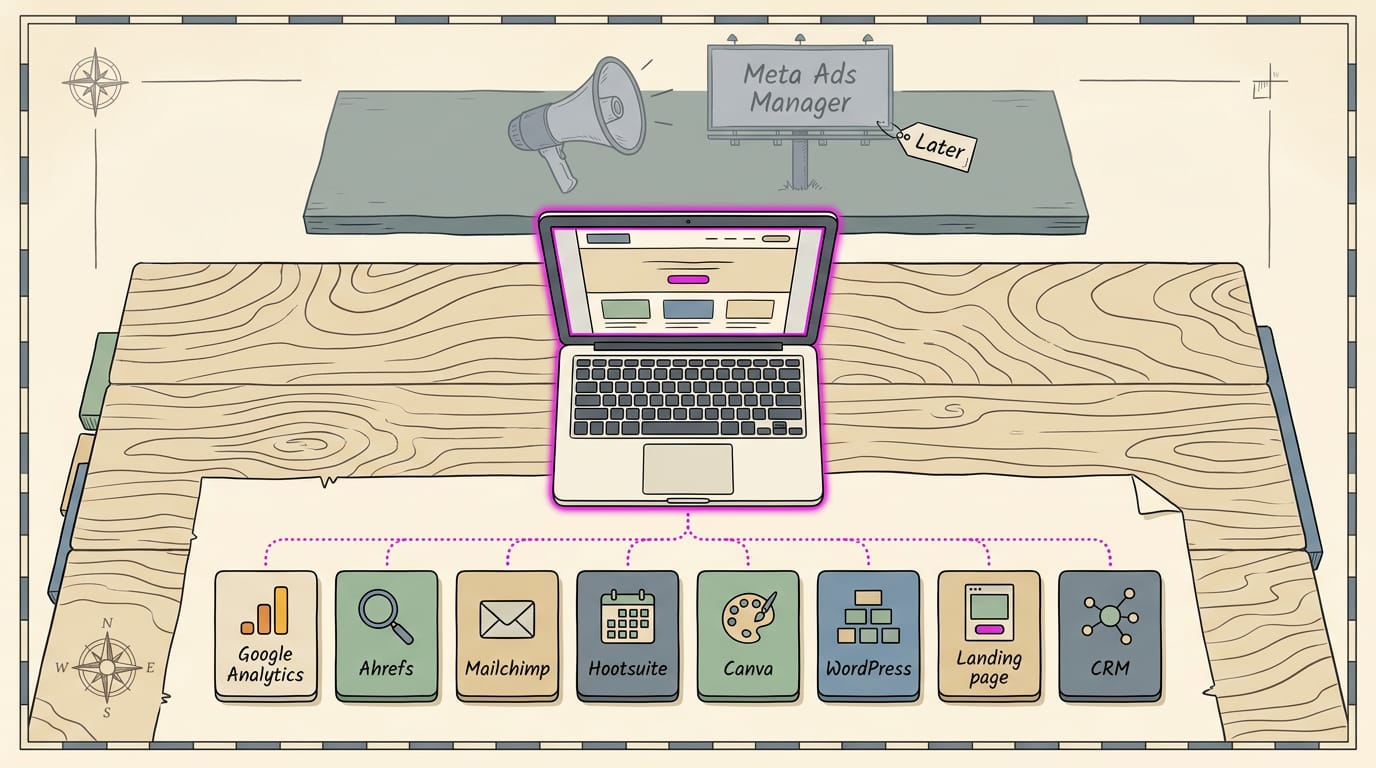
Tools change, but most jobs rely on the same core set. Learn the website and listing tools first, and leave ad platforms for later.
- Google Analytics: shows how visitors find your site and where they leave.
- Semrush or Ahrefs: SEO platforms for researching search phrases and checking competitors.
- Meta Ads Manager: where you build and measure ads on Facebook and Instagram.
- Mailchimp: sends email newsletters and tracks who opens them.
- Hootsuite: schedules and manages social media posts in one place.
- Canva: makes clean graphics without design experience.
- WordPress: a widely used system for building and editing websites.
- Landing page builders: make one focused page that asks visitors to call, book, or sign up.
Everyday skills that matter most
Software gets you started, but everyday skills keep you useful.
- Communication and collaboration: explaining ideas plainly to owners, front-desk staff, and writers.
- Creativity: finding a fresh angle for a post, offer, or photo.
- Decision-making: choosing the next best action when you can’t do everything at once.
- Data analysis: reading the numbers to see what’s working.
Think of a plumber who sees most new calls coming from one neighborhood. He focuses his next posts and review requests there, so his effort follows the calls.
It’s less about which app you know and more about how you think through a customer’s problem.
Gain Experience and Build a Portfolio
Reading about digital marketing only gets you so far. Clients want proof, so let’s build yours.
Practice projects you can start now
Start with what you have. A mock campaign is a practice project: pick a real business, plan its promotion, and write the posts or ads you’d run. A personal blog and regular content, like three social posts a week, build the habit.
Then test one thing, like a new headline, track the results for two weeks, and write down what changed. Learning comes from testing ideas, not just reading about them.
Volunteering and freelancing for real clients
Real clients teach you faster than practice projects do. Consider a local animal rescue that needs its social media refreshed. You help for a few months and finish with a case study.
Offer your help to non-profits or local businesses, or find paid jobs on Upwork, Fiverr, or Contra.
When a client is happy, ask for reviews you can post. Agree on one number to track, like calls or bookings, and record where it started and where it ended.
If a salon owner’s online bookings climb after your work, that number becomes your strongest portfolio piece.
Showcase your work and personal brand
Your portfolio is where people decide whether to hire you. For each project, note the goal, the skills you used, such as email writing or search ads, and the result.
Keep your LinkedIn profile current, and consider a simple personal website that links to your best work.
A landing page is a single web page built to get one action, like a sign-up or a booking. Build one for a practice project and add it to your portfolio. Clients hire people who show their work, not people who only describe it. Proof beats promises.
Staying current and meeting peers
Marketing changes quickly, so keep learning on purpose:
- Communities. Join the LinkedIn and GrowthHackers communities, where marketers share questions and what’s working.
- Webinars and conferences. Webinars are online talks you can watch from your desk. Attend a conference when one comes near you.
- Experts and newsletters. Follow a few experts and subscribe to their newsletters.
- New tools. Test them regularly on a practice project. You don’t need to master every one, just know which are worth your time.
Stay curious and keep building.
Starting in digital marketing comes down to three moves: understand the careers, learn the core skills, and prove them with real work. For a local business, the order is just as simple.
Claim your map listing, earn reviews from happy customers, and make your website fast and easy to use on a phone.
Do those basics well, and paid ads and social media become useful add-ons instead of expensive guesses. Get found first, then earn the trust that makes the phone ring.
References
- Jobs in marketing — prospects.ac.uk (2026)
- How to become a digital marketer — edx.org (2025)
- Digital Marketing Skills in High Demand: Exploratory Study … — athensjournals.gr
- Is the Marketing Job Outlook Strong in 2025? — imcprofessional.medill.northwestern.edu
- Advertising Association and WARC Expenditure Report — warc.com
Questions
What is the 3-3-3 rule in marketing?
The 3-3-3 rule is a marketing shortcut for planning how to hold an audience’s attention: earn notice in about three seconds, make the message clear within three minutes, and give people a reason to remember or act on it over the next three days. It is a flexible guideline, not a fixed industry standard, so versions can differ.
What is gen Z in marketing?
Gen Z generally refers to people born from about 1997 to 2012. In marketing, it means understanding and reaching this generation through relevant channels and messages, often with mobile-friendly content, social platforms, authenticity, and clear values.
What is SEO in digital marketing?
SEO, or search engine optimization, is the work of improving a website and its listings so search engines can match them to relevant searches. It includes understanding the phrases people use and making useful, accessible pages that answer their needs. For local businesses, accurate map listings and location-relevant information also support visibility.
What are 5 careers in marketing?
Five marketing careers include SEO specialist, content marketer, email marketing specialist, social media manager, and marketing analyst. These roles focus on improving search visibility, creating content, communicating with subscribers, managing social channels, and measuring performance, respectively.
What are the latest digital marketing trends?
Current digital marketing trends include wider use of AI for research and content workflows, short-form video, creator partnerships, social platforms as search tools, and more personalized customer experiences. Privacy-conscious data collection and measurement also matter as businesses adapt to changing tracking rules. Which trends are most useful depends on the audience and the results a business needs.
How does email marketing work?
Email marketing works by collecting email addresses from people who choose to sign up, then sending them relevant messages such as newsletters, offers, or appointment reminders. Businesses can organize subscribers into groups, track actions such as opens and clicks, and use those results to improve future messages. Consent and a clear way to unsubscribe are essential.
How to learn digital marketing online for beginners?
Start with one beginner-friendly online course, such as Google Digital Garage or HubSpot Academy, and finish it before taking another. Then choose one channel, such as SEO or email, and practice with a personal or volunteer project. Track a useful outcome, like calls or sign-ups, and add the work and results to a portfolio.
Sources
- Digital Marketing Skills in High Demand: Exploratory Study ..., athensjournals.gr
- Is the Marketing Job Outlook Strong in 2025?, imcprofessional.medill.northwestern.edu
- Advertising Association and WARC Expenditure Report, warc.com
- Jobs in marketing | Prospects.ac.uk, prospects.ac.uk,
- How to become a digital marketer | edX, edx.org,